There are over a million college professors listed on RateMyProfessors.com, and he's ranked #1. In this candid interview, Randy Bott of Brigham Young University, talks about the downside of fame and how this particular social media tool has affected his life. Seems popularity has a price.
Bott talks about the good, the bad, and the ugly of RateMyProfessor.com, discusses the correlation between RateMyProfessor.com ratings and those conducted by the university, and offers some practical advice on how to reach your students. He even wrestles with the question “How do you rate RateMyProfessor.com as a tool for students and educators?” His answers may surprise you. (24 minutes)
It's hard to walk more than a few blocks in San Francisco, Chicago, or New York City without seeing the signs. You see them in windows and on doors. Those unmistakable placards are everywhere, at least where restaurants, bars and hotels are concerned.
Zagat has survived for more than 30 years by selling a product that is essentially the result of user generated content (UGC). The company has managed to leverage the wisdom of a nationwide restaurant-hungry crowd and convert those ratings into publications and promotional products that are sold to consumers and the businesses who feed their desires. And Zagat did it before social media and online rating tools were popular. While other rating and review portals have come online and added additional competition and perspective to this space, Zagat has been able to leverage a strong brand name.
Just ask Starbucks, Subway, and Red Robin, who all scored #1 in the 2009 Zagat Fast Food Survey, how much the Zagat brand means to them. Over 6100 respondents rated more than 100 fast food chains nationwide. The CEO's from the top chains are no doubt celebrating, and publicising, their consumer-generated ratings. Some of them have even posted the news on their company Facebook pages--an interesting comingling of old and new media.
If social media is about engaging people in conversation, it can be argued that Zagat was ahead of the curve. Started in 1979 by Tim and Nina Zagat, the Zagat Survey is now the largest source of worldwide ratings of restaurants, bars, hotels, nightclubs and even golf courses. Over 350,000 reviewers (Zagat calls them surveyors) from around the world provide reviews, express their opinion and help others in their search for a good place to eat, drink and be merry. Over 40,000 restaurants, hotels, nightclubs, golf courses, etc. are represented in the Zagat guides. As the social media ecosystem has evolved, so has Zagat. They now have over 1,600 fans on Facebook and 14,000 followers on Twitter.
A typical Zagat Guide is $15.95, or you can subscribe on their website for $24.95 and gain access to their worldwide ratings. There is no charge to do a review. Anyone can be a reviewer of a neighborhood restaurant--just ask President Obama who did a restaurant review himself for a local Chicago public television show while a state senator. Who knows, you might even see a Zagat review from this blogger...
Just in case you're wondering if the Zagat name really means that much, Starbucks recently incorporated the number one Zagat rating into their new advertising campaign. It must mean something. Read more...
We don't generally think of college students as customers of a particular school, but as a new fall semester begins let's pause to consider how the transaction between seller and buyer was initiated. It's called shopping, and it's never been easier to shop for a college.
It wasn't always that way. A generation ago, a high school guidance counselor showed you to a room full of college catalogs, the printed words and images beckoning you to come closer. A generation ago, many students, prodded by anxious parents, did the "college tour," sampling campuses and spontaneously interviewing indigenous students, faculty and staff. But that was then.
Leap forward a generation, and these methods seem not only antiquated, but inadequate for power shoppers. Today, you can now learn more about a college in an hour than you could have by enrolling for a semester a generation ago. Really.
Sure, the ThePrincetonReview.com beats the catalog room, and the rankings at US News and World Report is a great place to get some perspective on how colleges compare, but if you really want to experience a college, albeit virtually, YouTube, blogs, Twitter, Facebook and podcasts are ready resources. To prove this point, take a look at how much we learned about Arizona State University in less than an hour.
Once known for being a party school, ASU now ranks #28 in America’s Best College Buys by Forbes Magazine, and #350 in Forbe's list of the best colleges in the country. Okay, pretty basic stuff. Let's go deeper.
How does Arizona State University rate on CollegeProwler.com, a social media website providing student-written profiles and “report cards” of colleges and universities on such topics as academics, weather, off-campus dining, Greek life, and diversity? Looking at the rating for Greek life, for example, ASU currently rates a B-. There are also some “Quick Stats” that show there are 20 fraternities and 13 sororities, and that there are only 7% and 8% respectively of undergrad students in each. So much for the party school rep. Let's take this in a different direction.
Using Campus Buddy, a campus networking site that you sign up with using your Facebook account, you find out the average GPA of an Arizona State University student is 3.14, over 95% of applicants are admitted, and that 78% of second year students return. How much does it cost to go to Arizona State University? A quick search on Unigo.com shows that Arizona State University’s instate tuition is approximately $4,700, and out-of-state tuition is approximately $16,000. Affordable and it sounds like your odds of getting accepted are pretty good.
Next, let's search YouTube, which has become a prime social media tool for investigating a college. You can research and view the US News and World Report campus tour video series, see student interviews and homemade videos about college life, research fraternities and sororities, and preview course material posted on YouTube.com/EDU. A YouTube search of ASU results in a many hits including numerous ASU student interviews.
CollegeClickTV.com is a social media website with video interviews of students, professors and staff. These interviews touch on topics as varied as general campus life, clubs that can reserve lanes at the pool, and campus dining. Other hits include videos of school activities like band performances and practices, ASU football, and guest speaker appearances of President Obama at the May 2009 Commencement ceremony. Now we're rolling.
Is anyone blogging about their life at Arizona State University? First you visit Twitter, since those will be short and sweet. The results on Twitter show students tweeting about reports they are working, that the W.P. Cary School of Business is appealing to business and civic groups to recruit MBA students, and a link to a news story you might find interesting. Moving on, you search Google and find a number of blogs from specialty programs at Arizona State University, such as ASUMetals. This is an unofficial blog about Arizona State University’s metalsmithing degree program and the students who create jewelry and sculpture from metal. As you look further down the Google results page you see another blog, this one called ASU Blog, simply enough. This personal blog provides commentary on a number of "campus life" topics, from the controversial visit by President Obama to ASU security on the patrol for bike thieves on campus.
In less than 60 minutes you've "experienced" Arizona State University, enough to know whether it should be on your short list of college possibilities. Shopping for colleges in the era of social media is indeed easy. Paying for college and succeeding as a college student? That's another story.
Some people will tell you that life is better thanks to online review sites that aggregate “the wisdom of the crowd” on everything from movies to hotels to restaurants, and they may have a point. Looking for a terrific Thai restaurant in Tampa? Zagat or Yelp have got you covered. How about an affordable hotel in Houston? TripAdvisor.com is there for you. But what if you’re a college student looking for a fun, easy-to-understand physics professor at Penn State? Thanks to RateMyProfessors.com you can now find that too.
RateMyProfessors.com is a controversial website that gives students the opportunity to flip roles and grade their professors on a 5 point scale based on Average Easiness, Average Helpfulness, and Average Clarity. These elements factor into the Overall Quality rating, which is the average of the scores. Adding a little fun at the expense of the RMP’s credibility, students can also rate their professors’ physical appearance, yielding a Hotness total. Though an attractive professor earns a chili pepper icon, this rating does not affect the Overall Quality rating. Students can also add tips for succeeding in a course, something that is arguably helpful for an incoming student who wants to know what to expect.
Over 9 million students use RMP to pick their next professor or to rate one they've had experience with. Instead of trying to find friends or classmates who’ve spent a semester with a particular instuctor, students can use RMP to find information in less time than it takes to actually enroll in the course. Currently RMP has 10 million ratings on over one million professors in the United States, Canada, and the United Kingdom. Owned by the MTV Network, famous for music videos and content targeted at college-age consumers, RMP has been in operation since 1999. It’s popularity, however, has skyrocketed as more students using social networking applications like Facebook tell their friends about the site.
To get a good feel for how it works, let’s take a look at how a real student, frustrated with her math professor, used RMP to self-validate her concerns. Play the video below.
What’s interesting about this video (with over 19,000 YouTube views as of today) is the emotion you can sense from an obviously frustrated and perhaps even math-phobic student. But you also have to consider the instructor’s perspective. After all, it can’t be easy teaching general education math courses to students who may not want to be there in the first place. Let’s just say it’s not a formula for high ratings.
To be sure, there are many critics of RMP, especially among those professors who are getting hit the hardest with low ratings. While some students leave thoughtful posts that professors can use as a means of constructive criticism, others use the site as a convenient vehicle for venting frustrations with a given professor. It’s no surprise that most ratings are posted during midterms and after final semester grades are posted. It also appears, from a review of the site, that most students who post comments write them from extreme experiences, whether positive or negative.
RMP recently added a feature where professors can defend themselves and their pedagogical tactics. Each professor's page also includes a link that reads "Professors add your rebuttal here” where they can add their own comments to the ratings. Some professors have even added video comments, taking full advantage of a social media application that helps them personalize and energize their response. Let’s take a quick look at one such response.
Educators also cast doubt on the validity of ratings for extremely popular professors. Furthermore, RMP doesn’t have anything in place that requires students to have actually taken a class from a professor to rate them, so an individual in California who isn’t even a student could rate a professor in New York. Critics also worry that the majority of students using the site are upset about their grades, so they are more critical of the professor who issued it.
Yet RMP might be more accurate than most might think. A study conducted by Theodore Coladarci and Irv Komfield, at the University of Maine, found that the ratings on RMP are significantly correlated with the formal student evaluations traditionally conducted by the college or university at the end of the semester. Coladarci is quick to point out, however, that the correlations aren’t universally high, noting that instructors who get high ratings on RMP also tend to get high ratings from their own institution’s evaluation system. Instructors with lower RMP ratings don’t necessarily have high correlations.
As a result of their research, Coladarci and Komfield suggest that professors put their official student evaluations online or that colleges create their own rating systems using similar technology to aggregate student feedback, a controversial recommendation itself. That said, some schools are already doing this.
Northwestern University has such a site for their students. In order to have accurate data with several evaluations, the university requires students to fill out evaluations for courses they have already completed before they can view the evaluations of their prospective professors. The result? Student evaluations increased by 80%, suggesting that the incentive to view evaluations while picking a professor could actually help improve the number of evaluations gathered by a university.
Some critics of publicizing student evaluations worry that negative comments, which have a longer half-life than positive ones, could damage a professor’s image, perhaps even a career. However, some observers think it may be beneficial for all parties to have the institutions themselves publish student evaluations. The anonymous founder of RateYourStudents.com, a blog created as a reaction to RMP, states that “publicizing professors who weren't meeting student expectations would encourage professors to try and address their weaknesses.”
Whether professors choose to publish their official evaluations online or not, RateMyProfessors.com won’t be going away anytime soon. Its momentum is worth noting. So is the evolving world of collaborative online ratings. If you can buy it, sell it, serve it, or consume it—it can be rated by your customers and prospective customers and then shared with anyone who wants to see it.
RateMyProfessors.com has demonstrated that even the life of the venerable college professor, the proverbial “sage on the stage,” is subject to the good, the bad, and the ugly of a disruptive technology in the social media ecosystem.
Welcome to September, a month (here in the U.S. anyway) associated with football, fall foliage, and going back to school. For this year's 18.4 million U.S. college students the campus experience is much different than it was a 20 years ago. What makes the experience different in 2009? Social media of course.
But before we dive into the impact of social media on campus, let's take a quick look at three aspects of going to college that have not changed much in a generation:
Alcohol consumption. No surprise here. It is still a major problem on most college campuses. A recent study by Outside the Classroom, a Boston-based company specializing in alcohol awareness, shows that 49.4% of students spend more time drinking than they do studying in a typical week.
Stress About Success. A survey, conducted by retail giant Walmart, shows that 65% of parents say that "doing well in school" is their #1 concern when it comes to their campus-bound children. Interestingly, 52% of college students said that doing well was their #1 concern. Not the same students who spend more time drinking than studying--do you think?
The Cost of Tuition and Textbooks. This year the average cost of attending a private four-year school is $25,143, up 5.9 percent from last year. A public four-college will average $6,585 this year, up 6.5 percent from last year. For those attending two-year community colleges tuition costs are up 4.7 percent from last year, running just over $2,400. In general, the price of textbooks have increased as well, but publishers are offering some innovative options (including free books) that are making the cost of content more affordable.
To summarize: Some college students drink too much, parents still worry about their kid's success in school, and everything is more expensive than it used to be.
Social Media on Campus
So where does social media play a role here? Almost everywhere you'll discover, and throughout the month we'll take a closer look at social media on campus and how it is changing the college experience. A sampling of what we'll be covering:
Sleuthing parents (and educators) can track student behaviors via social networking sites like Facebook. Whether they're having a libation or an evening at the library, you can know about it ... and maybe even see pictures or video. You better be sitting down for this.
How are students using social media to select a college? Conversely, how are colleges using social media to recruit and select their students? It's an information buffet to be sure.
Want to see what your kid's college chemistry class is up to? You might just find that her instructor is posting some of the more explosive classroom demonstrations on YouTube.
Listen to a course podcast; more professors than ever before are podcasting their lectures. Some amazing stuff.
Explore the blogosphere to see what little Johnny's professor is saying about his students, his area of academic expertise, or the Obama administration.
Learn more about Johnny's professor at RateMyProfessors.com, an online opinion aggregator that allows students to see what other students think about college professors.
The Social Media Basics
Ever the avuncular one, here's an opportunity to share some basics about social media before we venture onto campus. (Apologies to the social media savvy among you.) Two years ago most people were hard-pressed to define social media, and while applications like Facebook, YouTube, and Twitter have become ubiquitous names in casual conversation, there's still a lot of people who don't have a firm grasp on this thing called social media. So here's a quick primer that, hopefully, will make this month's theme more meaningful:
Social media is about enabling conversations using web-based applications. Human beings like to talk to each other. They recommend, they refer, they complain, they warn, they tell stories, they interact. They've always done these things and probably always will. Technology has allowed them to do it faster, more efficiently, and often with greater impact.
There are four things that social media allows you to do. We call these the four pillars of social media: Communication, Collaboration, Education, and Entertainment.
Social media tools and applications can seem endless and overwhelming, but they can be categorized or classified, just as biologists have done with the plant and animal kingdoms. Social media is an ecosystem where applications compliment each other or compete in a Darwinian struggle for survival--or in this case, the mindshare of the user.
The social media ecosystem--as we define it--is comprised of the 15 categories highlighted below. To be certain, there is overlap, and some applications fit into more than one category, but if you keep these categories in mind it will be a bit easier to label an application by its primary function. For example, Twitter is a kind of Social Networking application, but it is first and foremost a Microblogging tool. The categories:
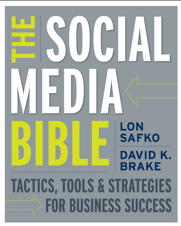
Please feel free to join the conversation by commenting on the blog posts you read here. Each week in September 2009 we'll have a drawing and give away two free copies of my book, The Social Media Bible (Wiley, 2009), to readers who become commentors. You don't have to agree. In fact, healthy conversation (especially among academics) often involves disagreement. Just join the conversation and collaborate ... or educate ... or entertain. You get the idea.
And don't forget to enjoy the fall foliage or the on-field conquests of your favorite college football team. (As for me, I'll be watching the leaves change on Arizona's Mogollon Rim and rooting for the BYU Cougars, remembering the national championship year of 1984. It's been 25 years. Time for another one.)
With the economy in the throes of the longest recession since the Great Depression, a lot of college students and their families are looking for ways to get more value out of every dollar spent on education. For those of you with a kid on campus, please note: this year the average tuition for a state college runs about $6,600 and $25,000 for a private university. That doesn't include room, board, or textbooks. Ouch.
Some families are opting for less prestigious schools with lower costs. Others are finding ways to save money elsewhere within the family budget, money that can be funneled to college expenses. Whatever you may be doing, Sallie Mae, formerly a government-sponsored entity, now independent, who specializes in student loans and college savings plans, wants to know.
More importantly, they want you to tell everyone you know how your family is saving money for college ... and it could be worth $5,000.
In a clever attempt to harness the power of user generated content (UGC) on the web, Sallie Mae is sponsoring a contest that will award a $5,000 scholarship to the best 30-second student video. Entrants are encouraged to post their video on the Sallie Mae site and then tell their friends, fans, and followers to vote for them. Those receiving the greatest number of votes will be vetted and evaluated by a panel of Sallie Mae-appointed judges who will determine a list of finalists. In an American Idol-style vote, the finalists will have their videos subjected to the wisdom of the crowd, and a winner will be crowned.
By going viral with a cavalcade of videos, Sallie Mae hopes to bring more attention to the plight of cash-strapped college students ... and their families. The strategy could also be good for Sallie Mae stock holders, who since 2004 when the company's ties to the government were finally cut, have been quick to invest in this well-regarded member of the Fortune 500. Getting the word out is part of Sallie Mae's strategy to sell more stuff, and UGC seems to be the foundation of their viral strategy.
To date there have been 279 videos entered into the contest which ends on August 25, 2009. Not surprisingly these videos run the gamut in terms of their production quality and themes. Take a look for yourself.
In the interest of full disclosure, I don't own stock in Sallie Mae, but I do have at least one college student in the house who has entered the contest with high hopes of making it to the final round. Because of my background in textbook publishing, her financial challenge (and mine) is complicated by the fact that we discourage the purchase of used books. (More on that in an upcoming blog post.)
So while I detest blatant self-promotion, I'm not beyond promoting the work of someone very close to me. Have a look at the work of Sydney Brake, and vote for her for goodness sakes ... every day until the contest ends. Sallie and Sydney will thank you.
If you're hungry in New York City and want something quick, find a food cart vendor. These ubiquitous wheels with meals serve up a wide variety of surprisingly good things to eat. Once you've found a Big Apple vendor you really like, however, the challenge is finding him again.
Unlike restaurants with addresses and yellow page ads (remember those?), food carts can't always be on the same corner. So if yesterday you enjoyed your Jamaican jerked chicken with peppered rice on the corner of 48th and Avenue of the Americas, there's no guarantee you'll find the same food cart there tomorrow.
But now, thanks to Twitter and some social media-savvy food cart vendors, there's no need to let your lunch on the street be left to luck. A growing number of street food vendors in the city are using Twitter to keep satisfied customers coming back ... or two blocks east of where you were yesterday.
Vendors are tweeting their customers details about what's for lunch. Some even include pictures. (Indeed, a thousand words may be worth more than 140 characters when you're hungry.) Come 11:30 and a tweet comes up from a favorite noodle cart touting the special of the day and the cart's location ... well, there's a good chance that's what's for lunch. But more than that, these vendors are combining social media with street smarts in a traditional strategy of retaining customers by making it easy to buy again. And it doesn't take 50,000 followers to make it work. As long as you've got the right followers, the world can be your oyster ... or green chile pork burrito as the case may be. Read more...
This blog takes a closer look at social media success stories, mistakes, miscalculations, and the people behind them. Fall theme: Social Media on the college campus.
David K. Brake is an entrepreneur, author, and veteran of the publishing industry.



 Posts
Posts


