Showing posts with label Social Media. Show all posts

Monday, September 14, 2009

A Social Media Snapshot:
Can You Run Away From Your Social Media Footprint?

Is it possible to run away from the digital footprints you’ve left in the social media ecosystem? Evan Ratliff, a contributor to Wired Magazine, believed he could do it for 30 days. The catch: he had to become born-again, with a new social media persona.

He lasted 24 days, and believe it or not, it was an amateur cyber-sleuth and a gluten-free pizza that finally did him in.


Listen to his story. From NPR’s On the Media.


Tuesday, September 8, 2009

A Social Media Snapshot:
Have We Forgot Zagat? Hardly ... They Were So Ahead of the Social Media Curve

It's hard to walk more than a few blocks in San Francisco, Chicago, or New York City without seeing the signs. You see them in windows and on doors. Those unmistakable placards are everywhere, at least where restaurants, bars and hotels are concerned.

Zagat has survived for more than 30 years by selling a product that is essentially the result of user generated content (UGC). The company has managed to leverage the wisdom of a nationwide restaurant-hungry crowd and convert those ratings into publications and promotional products that are sold to consumers and the businesses who feed their desires. And Zagat did it before social media and online rating tools were popular. While other rating and review portals have come online and added additional competition and perspective to this space, Zagat has been able to leverage a strong brand name.

Just ask Starbucks, Subway, and Red Robin, who all scored #1 in the 2009 Zagat Fast Food Survey, how much the Zagat brand means to them. Over 6100 respondents rated more than 100 fast food chains nationwide. The CEO's from the top chains are no doubt celebrating, and publicising, their consumer-generated ratings. Some of them have even posted the news on their company Facebook pages--an interesting comingling of old and new media.

If social media is about engaging people in conversation, it can be argued that Zagat was ahead of the curve. Started in 1979 by Tim and Nina Zagat, the Zagat Survey is now the largest source of worldwide ratings of restaurants, bars, hotels, nightclubs and even golf courses. Over 350,000 reviewers (Zagat calls them surveyors) from around the world provide reviews, express their opinion and help others in their search for a good place to eat, drink and be merry. Over 40,000 restaurants, hotels, nightclubs, golf courses, etc. are represented in the Zagat guides. As the social media ecosystem has evolved, so has Zagat. They now have over 1,600 fans on Facebook and 14,000 followers on Twitter.

A typical Zagat Guide is $15.95, or you can subscribe on their website for $24.95 and gain access to their worldwide ratings. There is no charge to do a review. Anyone can be a reviewer of a neighborhood restaurant--just ask President Obama who did a restaurant review himself for a local Chicago public television show while a state senator. Who knows, you might even see a Zagat review from this blogger...

Just in case you're wondering if the Zagat name really means that much, Starbucks recently incorporated the number one Zagat rating into their new advertising campaign. It must mean something. Read more...

Monday, September 7, 2009

Social Media on Campus
Before They Were Students, They Were Prospective Customers


We don't generally think of college students as customers of a particular school, but as a new fall semester begins let's pause to consider how the transaction between seller and buyer was initiated. It's called shopping, and it's never been easier to shop for a college.

It wasn't always that way. A generation ago, a high school guidance counselor showed you to a room full of college catalogs, the printed words and images beckoning you to come closer. A generation ago, many students, prodded by anxious parents, did the "college tour," sampling campuses and spontaneously interviewing indigenous students, faculty and staff. But that was then.

Leap forward a generation, and these methods seem not only antiquated, but inadequate for power shoppers. Today, you can now learn more about a college in an hour than you could have by enrolling for a semester a generation ago. Really.

Sure, the ThePrincetonReview.com beats the catalog room, and the rankings at US News and World Report is a great place to get some perspective on how colleges compare, but if you really want to experience a college, albeit virtually, YouTube, blogs, Twitter, Facebook and podcasts are ready resources. To prove this point, take a look at how much we learned about Arizona State University in less than an hour.

Once known for being a party school, ASU now ranks #28 in America’s Best College Buys by Forbes Magazine, and #350 in Forbe's list of the best colleges in the country. Okay, pretty basic stuff. Let's go deeper.

How does Arizona State University rate on CollegeProwler.com, a social media website providing student-written profiles and “report cards” of colleges and universities on such topics as academics, weather, off-campus dining, Greek life, and diversity? Looking at the rating for Greek life, for example, ASU currently rates a B-. There are also some “Quick Stats” that show there are 20 fraternities and 13 sororities, and that there are only 7% and 8% respectively of undergrad students in each. So much for the party school rep. Let's take this in a different direction.
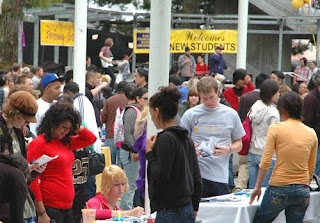
Using Campus Buddy, a campus networking site that you sign up with using your Facebook account, you find out the average GPA of an Arizona State University student is 3.14, over 95% of applicants are admitted, and that 78% of second year students return. How much does it cost to go to Arizona State University? A quick search on Unigo.com shows that Arizona State University’s instate tuition is approximately $4,700, and out-of-state tuition is approximately $16,000. Affordable and it sounds like your odds of getting accepted are pretty good.

Next, let's search YouTube, which has become a prime social media tool for investigating a college. You can research and view the US News and World Report campus tour video series, see student interviews and homemade videos about college life, research fraternities and sororities, and preview course material posted on YouTube.com/EDU. A YouTube search of ASU results in a many hits including numerous ASU student interviews.

CollegeClickTV.com is a social media website with video interviews of students, professors and staff. These interviews touch on topics as varied as general campus life, clubs that can reserve lanes at the pool, and campus dining. Other hits include videos of school activities like band performances and practices, ASU football, and guest speaker appearances of President Obama at the May 2009 Commencement ceremony. Now we're rolling.

Is anyone blogging about their life at Arizona State University? First you visit Twitter, since those will be short and sweet. The results on Twitter show students tweeting about reports they are working, that the W.P. Cary School of Business is appealing to business and civic groups to recruit MBA students, and a link to a news story you might find interesting. Moving on, you search Google and find a number of blogs from specialty programs at Arizona State University, such as ASUMetals. This is an unofficial blog about Arizona State University’s metalsmithing degree program and the students who create jewelry and sculpture from metal. As you look further down the Google results page you see another blog, this one called ASU Blog, simply enough. This personal blog provides commentary on a number of "campus life" topics, from the controversial visit by President Obama to ASU security on the patrol for bike thieves on campus.

In less than 60 minutes you've "experienced" Arizona State University, enough to know whether it should be on your short list of college possibilities. Shopping for colleges in the era of social media is indeed easy. Paying for college and succeeding as a college student? That's another story.


Contributor to this blog: Miachelle DePiano

Tuesday, September 1, 2009

Social Media on Campus
Back to School


Welcome to September, a month (here in the U.S. anyway) associated with football, fall foliage, and going back to school. For this year's 18.4 million U.S. college students the campus experience is much different than it was a 20 years ago. What makes the experience different in 2009? Social media of course.

But before we dive into the impact of social media on campus, let's take a quick look at three aspects of going to college that have not changed much in a generation:


  1. Alcohol consumption. No surprise here. It is still a major problem on most college campuses. A recent study by Outside the Classroom, a Boston-based company specializing in alcohol awareness, shows that 49.4% of students spend more time drinking than they do studying in a typical week.

  2. Stress About Success. A survey, conducted by retail giant Walmart, shows that 65% of parents say that "doing well in school" is their #1 concern when it comes to their campus-bound children. Interestingly, 52% of college students said that doing well was their #1 concern. Not the same students who spend more time drinking than studying--do you think?
  3. The Cost of Tuition and Textbooks. This year the average cost of attending a private four-year school is $25,143, up 5.9 percent from last year. A public four-college will average $6,585 this year, up 6.5 percent from last year. For those attending two-year community colleges tuition costs are up 4.7 percent from last year, running just over $2,400. In general, the price of textbooks have increased as well, but publishers are offering some innovative options (including free books) that are making the cost of content more affordable.

To summarize: Some college students drink too much, parents still worry about their kid's success in school, and everything is more expensive than it used to be.

Social Media on Campus

So where does social media play a role here? Almost everywhere you'll discover, and throughout the month we'll take a closer look at social media on campus and how it is changing the college experience. A sampling of what we'll be covering:


  1. Sleuthing parents (and educators) can track student behaviors via social networking sites like Facebook. Whether they're having a libation or an evening at the library, you can know about it ... and maybe even see pictures or video. You better be sitting down for this.
  2. How are students using social media to select a college? Conversely, how are colleges using social media to recruit and select their students? It's an information buffet to be sure.

  3. Want to see what your kid's college chemistry class is up to? You might just find that her instructor is posting some of the more explosive classroom demonstrations on YouTube.

  4. Listen to a course podcast; more professors than ever before are podcasting their lectures. Some amazing stuff.

  5. Explore the blogosphere to see what little Johnny's professor is saying about his students, his area of academic expertise, or the Obama administration.

  6. Learn more about Johnny's professor at RateMyProfessors.com, an online opinion aggregator that allows students to see what other students think about college professors.

The Social Media Basics

Ever the avuncular one, here's an opportunity to share some basics about social media before we venture onto campus. (Apologies to the social media savvy among you.) Two years ago most people were hard-pressed to define social media, and while applications like Facebook, YouTube, and Twitter have become ubiquitous names in casual conversation, there's still a lot of people who don't have a firm grasp on this thing called social media. So here's a quick primer that, hopefully, will make this month's theme more meaningful:

  1. Social media is about enabling conversations using web-based applications. Human beings like to talk to each other. They recommend, they refer, they complain, they warn, they tell stories, they interact. They've always done these things and probably always will. Technology has allowed them to do it faster, more efficiently, and often with greater impact.

  2. There are four things that social media allows you to do. We call these the four pillars of social media: Communication, Collaboration, Education, and Entertainment.

  3. Social media tools and applications can seem endless and overwhelming, but they can be categorized or classified, just as biologists have done with the plant and animal kingdoms. Social media is an ecosystem where applications compliment each other or compete in a Darwinian struggle for survival--or in this case, the mindshare of the user.

  4. The social media ecosystem--as we define it--is comprised of the 15 categories highlighted below. To be certain, there is overlap, and some applications fit into more than one category, but if you keep these categories in mind it will be a bit easier to label an application by its primary function. For example, Twitter is a kind of Social Networking application, but it is first and foremost a Microblogging tool. The categories:
*Social Networking *Publishing *Photo *Audio *Video *Microblogging *Livecasting *Virtual Worlds *Gaming *Productivity Applications *Aggregators *RSS *Search *Mobile *Interpersonal

Join the Conversation

Please feel free to join the conversation by commenting on the blog posts you read here. Each week in September 2009 we'll have a drawing and give away two free copies of my book, The Social Media Bible (Wiley, 2009), to readers who become commentors. You don't have to agree. In fact, healthy conversation (especially among academics) often involves disagreement. Just join the conversation and collaborate ... or educate ... or entertain. You get the idea.

And don't forget to enjoy the fall foliage or the on-field conquests of your favorite college football team. (As for me, I'll be watching the leaves change on Arizona's Mogollon Rim and rooting for the BYU Cougars, remembering the national championship year of 1984. It's been 25 years. Time for another one.)

Monday, August 3, 2009

A Social Media Snapshot:
Sallie Mae Goes Viral


With the economy in the throes of the longest recession since the Great Depression, a lot of college students and their families are looking for ways to get more value out of every dollar spent on education. For those of you with a kid on campus, please note: this year the average tuition for a state college runs about $6,600 and $25,000 for a private university. That doesn't include room, board, or textbooks. Ouch.


Some families are opting for less prestigious schools with lower costs. Others are finding ways to save money elsewhere within the family budget, money that can be funneled to college expenses. Whatever you may be doing, Sallie Mae, formerly a government-sponsored entity, now independent, who specializes in student loans and college savings plans, wants to know.


More importantly, they want you to tell everyone you know how your family is saving money for college ... and it could be worth $5,000.


In a clever attempt to harness the power of user generated content (UGC) on the web, Sallie Mae is sponsoring a contest that will award a $5,000 scholarship to the best 30-second student video. Entrants are encouraged to post their video on the Sallie Mae site and then tell their friends, fans, and followers to vote for them. Those receiving the greatest number of votes will be vetted and evaluated by a panel of Sallie Mae-appointed judges who will determine a list of finalists. In an American Idol-style vote, the finalists will have their videos subjected to the wisdom of the crowd, and a winner will be crowned.


By going viral with a cavalcade of videos, Sallie Mae hopes to bring more attention to the plight of cash-strapped college students ... and their families. The strategy could also be good for Sallie Mae stock holders, who since 2004 when the company's ties to the government were finally cut, have been quick to invest in this well-regarded member of the Fortune 500. Getting the word out is part of Sallie Mae's strategy to sell more stuff, and UGC seems to be the foundation of their viral strategy.


To date there have been 279 videos entered into the contest which ends on August 25, 2009. Not surprisingly these videos run the gamut in terms of their production quality and themes. Take a look for yourself.


In the interest of full disclosure, I don't own stock in Sallie Mae, but I do have at least one college student in the house who has entered the contest with high hopes of making it to the final round. Because of my background in textbook publishing, her financial challenge (and mine) is complicated by the fact that we discourage the purchase of used books. (More on that in an upcoming blog post.)


So while I detest blatant self-promotion, I'm not beyond promoting the work of someone very close to me. Have a look at the work of Sydney Brake, and vote for her for goodness sakes ... every day until the contest ends. Sallie and Sydney will thank you.


Sunday, August 2, 2009

A Social Media Snapshot:
Street Food Meets Social Media


If you're hungry in New York City and want something quick, find a food cart vendor. These ubiquitous wheels with meals serve up a wide variety of surprisingly good things to eat. Once you've found a Big Apple vendor you really like, however, the challenge is finding him again.

Unlike restaurants with addresses and yellow page ads (remember those?), food carts can't always be on the same corner. So if yesterday you enjoyed your Jamaican jerked chicken with peppered rice on the corner of 48th and Avenue of the Americas, there's no guarantee you'll find the same food cart there tomorrow.

But now, thanks to Twitter and some social media-savvy food cart vendors, there's no need to let your lunch on the street be left to luck. A growing number of street food vendors in the city are using Twitter to keep satisfied customers coming back ... or two blocks east of where you were yesterday.

Vendors are tweeting their customers details about what's for lunch. Some even include pictures. (Indeed, a thousand words may be worth more than 140 characters when you're hungry.) Come 11:30 and a tweet comes up from a favorite noodle cart touting the special of the day and the cart's location ... well, there's a good chance that's what's for lunch. But more than that, these vendors are combining social media with street smarts in a traditional strategy of retaining customers by making it easy to buy again. And it doesn't take 50,000 followers to make it work. As long as you've got the right followers, the world can be your oyster ... or green chile pork burrito as the case may be. Read more...

Wednesday, July 15, 2009

Tweets on the Streets
of Le Tour
on Bastille Day

Why is Lance Armstrong, a guy who rides a bike, the most social media-savvy athlete in the world? We’ll answer that in a moment, but first …

Yesterday was Bastille Day in France, a national holiday commemorating the beginning of the French Revolution in 1789. It was also Stage 10 of the Tour De France, a relatively flat, uneventful ride from the town of Limoges to Issoudon, won in a sprint finish by Mark Cavendish, a Brit. You would have known about this if you’re one of the 1.4 million people who follow Lance Armstrong on Twitter. Let’s take a peek at some of yesterday's tweets from the master pedaler:

Driving to the start. Slight drizzle. Bastille Day. A Brit will win tho.
    Shot a video with @ghincapie and Mark Cavendish this morning. Good fun altho Cav was too well behaved.
    St10 done. Probably one of the more relaxed days I have experienced in 10+ tours. Got roling at the end tho and we were going! Good legs.
    Kept going @ the finish and did a 10 min cool down. I reckon it makes no sense to sprint to the line, stop cold, then sit in the bus.

      As it turned out, a Brit (Cavendish) did win the stage, just as Armstrong predicted.

      Later in the day, Armstrong introduces us (via a CNN link) to the Chalkbot, a street-writing robot that transcribes water-soluble messages of hope and inspiration to riders, fans and a world-wide television audience that includes legions of cancer survivors. The Chalkbot is a towed, two-wheeled device that converts the tweets and text messages of ordinary fans into bright yellow comments that get painted on the streets of the Tour for all to see. Thus, a fortunate fan from Philly can write a message on a boulevard in France and receive a photo of that message, presumably to share with friends via social media. (Is it any wonder that Nike and Armstrong are working with the company that invented the Chalkbot, bringing a new form of user generated content to a street near you.)

      The Chalkbot isn’t the only one writing on the streets of the Tour, however. We learn from Chris Brewer, reporting on the LiveStrong website:


      At the beginning and end of each stage Nike has a “street team” of 12 super-motivated young people patrolling the fans along the rail. Each of them has a roller bag chock full of chalk(!) and LIVESTRONG yellow wristbands. They give out the chalk for free, encouraging people to write messages of hope on the roads of the Tour, and sell the wristbands for one Euro with all proceeds staying in France to benefit those affected by cancer.


      A little later we get another tweet from Lance about the video he, Hincapie, and Cavendish shot in the morning:


      Pre-stage video with @ghincapie, Cav, and myself.

      And speaking of videos, on Sunday morning Robin Williams was on the Team Astana bus, doing what Robin Williams does best, being funny. Where did we learn about this? From one of Armstrong’s tweets, of course.


      Robin Williams stopped by the bus after the finish. He's doing great and got his health back 100%. We made a vid I'll post later. Too funny.

      So, what makes Armstrong the most social media-savvy athlete in the world? He understands that social media is about engaging your audience in conversation. The Armstrong you get to know via his tweets, blogs, vlogs and Livestrong.com is endearing and real, everything you would want in a friend. In fact, the Armstrong you get to know via social media is a much more compelling persona than the Armstrong you see in a Charlie Rose interview, for example. Why? Because mass media doesn't always capture the Lance you want to have a beer with. The mass media Lance is awe-inspiring and iconic yet packaged and controlled. That's not a bad thing--that's just how mass media sells our stars to us. The social media Armstrong, by contrast, is a multi-dimensional Armstrong.


      And then there is his strategic side. You don't win the Tour De France seven times without being strategic. Not surprisingly, Armstrong has mastered a social media strategy that taps into the Four Pillars of Social Media:


      1. Communication

      2. Collaboration

      3. Education

      4. Entertainment

      He employs a number of different social media tools to establish all four pillars as the foundation for his brand-enhancing self. Let us not forget that he is one of the world's most effective pitchmen. Check out some of the sponsors and advertisements on his website, and you'll see that his cancer-crusading foundation is making money, over $250 million in the last 12 years. (Armstrong's personal net worth is well over $100 million, according to Forbes.)


      Clearly, social media didn't make Lance Armstrong. His talent on a bicycle and his backstory as a cancer survivor have given Armstrong an opportunity to be in the public spotlight. But it is his use of social media that has given all of us an opportunity to ride along with him ... and feel good about it.

      Monday, July 6, 2009

      A Social Media Snapshot:
      The Spy Who Shew Too Much

      In a story that could be a sub-plot in a social media-themed James Bond flick, the newly designated head of Britain's Secret Intelligence Service (the MI6), has had detailed information about him, his family, friends, and home posted on the Internet for all to see. Not a good scenario for someone who must live in the shadowy, super-secret world of the spy trade.

      How did it happen you ask? Did an Octopussy-like villan intercept his tweets? Was he "friended" by Jaws on FaceBook? No, but his wife, Lady Shelley Sawers, uploaded all of this information to a public-facing Facebook page sans privacy protection. (Even with privacy settings in place it may not have been a good idea.)

      Though the information was quickly pulled, the damage was done. Any one of 200 million Facebook users could access the information which contained family vacation photos, photos of friends, many of whom are diplomats, the Sawers' flat in London--you get the idea. The mistep may keep Sir John Sawers from assuming the top spy job, as it raises serious doubts about his ability to perform that job.

      Hey, even spies have lives, wives (or husbands), and the very human need to share special moments with friends and family. Social media is the great enabler, a veritable toolbox of applications to keep family and friends tethered and in touch. Except when your life and the lives of those around you could be jeopardized.

      We can learn a valuable lesson from the Sawers' revealing experience. Social media has a dark side that can be the arch rival of privacy, and while you may not earn your living in the shadows, there may be moments from your life that should remain there.

      Miss Moneypenny would be horrified. Read more...

      Saturday, July 4, 2009

      Social Media in 1776: How a Corset Maker Engaged a Nation


      The Declaration of Independence was formally accepted by the Continental Congress on July 4th, 1776. The missive consists of 1,137 words penned on parchment paper, words that changed the course of world history. Thomas Jefferson is widely viewed as the "author" of the document, but it was truly a collaborative effort. (Interestingly, many of his colonial collaborators found Jefferson to be too wordy, and the final document was edited considerably before realizing its final form. Among the things his collaborators removed was a lengthy indictment of the slave trade ... ironic.)

      We can only imagine how a wiki may have aided the founding brothers in creating the finished piece that we celebrate today. If a wiki would have been a tool of those times, surely some of Jefferson's collaborators would have been tweeting details of their conversations to their cohorts throughout the colonies, tweets that would have fueled countless blogs no doubt. But alas, there was no web 2.0 in 1776.

      There was, however, social media. By turning the calendar back six months to January 9, 1776, we witness the publication of Common Sense, a 55-page pamphlet that argued strongly for colonial independence. Though the first printing was published anonymously, we all know that the author was Thomas Paine, whose rogue spirit has influenced countless journalists over the years and several of today's top bloggers, whether they realize it or not.

      Upon publication, Common Sense was very popular and in a little more than a month had gone into a third printing. Everyone was talking about it. Paine, who had apprenticed as a corset maker and worked in that trade on and off during his lifetime, played a huge role in engaging colonial America in conversation. Common Sense was indeed a social medium. Here's a taste of Paine, from the opening pages of Common Sense:

      Some writers have so confounded society with government, as to leave little or no distinction between them; whereas they are not only different, but have different origins. Society is produced by our wants, and government by our wickedness; the former promotes our happiness positively by uniting our affections, the latter negatively by restraining our vices. The one encourages intercourse, the other creates distinctions. The first is a patron, the last a punisher.

      Paine did not grown up in the colonies. He was born in Thetford, England in 1737. He came to America in 1774, encouraged by Benjamin Franklin. Paine's migration here may have been facilitated by his dismissal from his job as an excise officer. He was fired for writing a pamphlet that called on Parliament to increase the salaries of excise officers. Seems his calling as a "rabble rouser" with a pen was becoming clear to him.

      Today we celebrate America's Declaration of Independence, but we might also want to contemplate the concept of independence and an early form of social media that enabled a new nation to engage in one of the most important conversations in history.

      Where else but in America could a immigrant corset maker with an opinion have had such an impact on a nation? Read more...


      Tuesday, June 23, 2009

      Snapshot Post--
      Mini-Musings on The Good, the Bad, & the Ugly


      Social Media-Enabled Criminals, Do Ya Feel Lucky?


      Humans have a fundamental need to document their vacations. Early in the 20th Century, Kodak built a business around this behavior. Likewise with the publishers of picture post cards. "Wish you were here," became a ubiquitous phrase synonymous with 25-cent postcards sent by vacationing family and friends.

      In the age of social media, the Kodak moments and post cards from the tropics have been replaced by photos, videos and text messages sent from a smart phone. "Wish you were here" sentiments are instantly sent to and received by a close circle of people who care.

      But what happens when you've embraced FaceBook and Twitter to the point that you're posting those vacation photos and updates for legions of friends and followers, some of whom you don't know at all?

      Say hello to social media-enabled criminals. They simply follow your social media footprints, and while you're sipping a fancy umbrella drink on the sandy shores of paradise, they're rummaging through your underwear drawer looking for valuables. (Isn't that where you keep your valuables?)

      You can forward the mail, cancel the newspaper, and leave the lights on timers, but if your tweets tell another story, you're vulnerable.

      Seems Israel and Noell Hyman, a couple from Arizona, did all those things and were burgled during their vacation. Hindsight being what it is, they blame Twitter. Mr. Hyman, the owner of an online video business that he tweets about regularly, thinks the stolen items (video editing equipment) were so specific that at least one of his followers must have succumbed to his (or her) inner criminal.

      A cautionary tale, to be sure. But a potent sign of the times. Read more...

      NOTE to any social media-enabled criminal who might read this blog or follow my tweets:

      I know what you're thinking. "Did he fire six tweets or only five?" Well, to tell you the truth, in all this excitement I kind of lost track myself. But being as this is a .44 Magnum, the most powerful handgun in the world, and would blow your head clean off, you've got to ask yourself one question: Do I feel lucky? Well, do ya, punk?
      (Apologies to Clint Eastwood for revising this line from his 1971 film Dirty Harry--ever so slightly.)

      Monday, June 22, 2009

      Snapshot Post--
      Mini-Musings on The Good, the Bad, & the Ugly


      Wanted: Your Social Media Footprint and Passwords


      The city government of Bozeman, Montana, population 27, 509 has managed to step into a social media mess, infuriating people to the point that the City Attorney has been receiving an email a minute, some from as far away as the UK.

      What dastardly thing has Bozeman done? Ask their HR department. The city has impleted new requirements for potential job interviewees. People wanting jobs with the city of Bozeman must sign a waiver allowing investigation of not just their past employment, criminal background and credit history, but all of their online activity: Twitter, Facebook, YouTube, blogs, websites, you name it. If that's not enough to ring your privacy bell, consider this: these job applicants are required to hand over their passwords to their accounts to whomever is taking their application.
       
      Identity theft is one thing, but this may be a case of superhighway robbery with the masked bandits operating under the benevolent banner of local government. Not surprisingly, Bozeman's new HR policy has set off a barrage of social media crossfire; tweets are flying and a poll done by the local CBS affiliate, KBZK (http://www.kbzk.com), had almost 5,000 responses within 24 hours of the story breaking ... with 98% of respondents against the city's policy.

      This situation underscores what can happen when a zealous few at City Hall decide to use the ugly side of social media, but it also points out that in an open society social media introduces a dose of self-correction ... the wisdom of the crowd can prevail.

      The City of Bozeman's HR department is now looking into these hiring requirements to see if there should be limits on the social media footprints that they should follow. Read more...

      UPDATE: Shortly after this post went live we learned that the City of Bozeman revised it's screening process for job applicants. Passwords are no longer required. But potential employees everywhere beware: your social media footprints still have a half-life that can come back to haunt you when you least expect it ... with or without handing over your passwords.

      Saturday, June 20, 2009

      Snapshot Post--
      Mini-Musings on The Good, the Bad, & the Ugly


      Make Them Eat Grasshoppers


      It's simple enough. You've changed your company name, rebranded yourself, and now want to get the word out. You want to get people's attention, get them talking among themselves about your company. What do you do?

      If you're Grasshopper, a company that provides toll-free telephone numbers for small businesses, you spend two months compiling a list of 5,000 luminaries that included celebrities, TV anchors, bloggers, journalists, and CEOs. Then, you FedEx them all a package of chocolate-covered grasshoppers, with a promotional message and a link to a YouTube.

      Bioterrorism? Hardly ... but definitely of form of viral marketing. The innovative campaign that blended traditional advertising with social media managed to generate news, videos, blogs, photos, and tweets. A quick look at the numbers:

    • 145,575 video views with 162 comments
    • 1,500 tweets
    • 120 blog posts in one month
    • 7 national TV mentions


    • Oh, and did I mention some of the people who received the suggestive snacks videoed themselves eating the chocolate-covered grasshoppers and uploaded them to YouTube? User-generated content at its best. Read more...

      Thursday, June 11, 2009

      Snapshot Post--
      Mini-Musings on The Good, the Bad, & the Ugly


      Social Media "Ruining" Your Life?


      Take one independent movie, a chick-flick to be sure, and a very small advertising budget. Add one social media-savvy actress, determined to get the word out and engage her audience. The result? An opening weekend with $3.5 million in box office revenues.

      Faced with an almost non-existent advertising budget, actress Nia Vardalos (of "My Big Fat Greek Wedding" fame) took matters into her own hands and employed a "personal" social media strategy to promote her new movie, "My Life in Ruins." Instead of billboards, bus stops and large space ads, she's using Twitter and YouTube. To date, her Twitter account has 5, 652 followers and 435 updates. Her YouTube posting has 18, 926 views.

      "My Life in Ruins" debuted at # 9 in the top ten movie money makers with $3.5 million for its first weekend. Not bad, considering it's in less than a third of the movie theaters that show the big budget films. That's one way to go from ruins to riches. For Nia Vardalos, it's just a beginning. Read more.

      Monday, June 8, 2009

      Are Your Customers SCREAMING to be Engaged?


      Here’s an idea that would have gotten you tossed out of business school just a few years ago: Take a multi-million dollar consumer brand like Doritos and turn it over to a bunch of 13 to 24 year-olds. Let them expand the product line, develop advertising campaigns and assume total control of the product’s image. A recipe for success you wonder, or the ingredients of a disaster?

      That’s exactly what the folks at Frito Lay Canada did with their Become the Doritos Guru contest that ended in May.

      The 11-week program encouraged consumers to come up with a new flavor for the Doritos tortilla chip brand and create a 30-second video commercial introducing it. To make things interesting Frito Lay Canada offered a $25,000 first prize and a 1% royalty on future sales of the product.

      Using a social media strategy, combined with some traditional integrated marketing techniques, the contest, which obviously doubled as an ad campaign, produced phenomenal results. A quick look at the numbers tells much of the story:

    • There were over 2,000 official entries
    • There were 1.5 million unique visitors to the contest’s YouTube page
    • The Doritos Guru FaceBook page attracted 30,000 fans
    • Sales of Doritos in Canada jumped 22% during the contest

      By letting so much user-generated content (UGC) go viral through their consumers’ social networks, Frito Lay Canada was able to engage their target audience in a way that simply would not have been possible a few years ago.

      To be sure, there were other things happening in the background:

    • Doritos partnered with MuchMusic, a Canadian music video channel, who aired several of the videos under a “Doritospiece Theatre” banner. MuchMusic even had their VJs screen and critique several of the entries.
    • An in-store retail program hyped the contest by using special displays that featured white bags of Doritos with a dollar sign ($) on the front.
    • The contest was promoted on Xbox Live games like Guitar Hero 4 and Transformers. (Yet another gaming connection.)

      Oh, and how about the winner? A 21 year-old Concordia film student, Ryan Coopersmith, and seven of his friends created a video showing people ranting, raving, and yelling in everyday situations. Though it sounds like anger management gone awry, it was oddly appropriate for their new flavor: Screamcheese (watch video).

      The video cost Coopersmith and his team (aka Boo Ya Pictures) all of $300. While estimates of what one percent of future Screamcheese sales could mean for the group (Frito Lay Canada says it will likely be a six figure number), the filmmakers are wasting no time on their road to success. They are investing $15,000 of their winnings into their first feature film. Look out Sundance.

      Not surprisingly, Frito Lay has already expressed a desire to maintain a relationship with Boo Ya Pictures. They’ll probably “do lunch” and discuss the future while sipping premium energy drinks and nibbling on Screamcheese Doritos.

      The take-home lesson: Giving consumers influence over your brand is going to happen whether you like it or not, so why not collaborate with them on the new frontier. Now there's something to scream about!
    • Sunday, June 7, 2009

      How “Mis-Tweeted” Missives Can Make Anyone Look Like a Twit


      Proving that it pays to know whether your social media tactics are engaging or enraging your audience, former Speaker of the House Newt Gingrich managed to shoot himself in the foot, via Twitter, not once, but twice in the last month.

      First he threatened legal action against a Twitter user and Twitter itself, a false alarm stemming from apparent confusion about how the social media tool works. Then he tweeted some sizzling political invective in the direction of Supreme Court nominee and Court of Appeals judge Sonia Sotomayor, which he then had to recant.

      Gingrich, an avid and stylish tweeter, probably misunderstood how tweets work when he instructed his attorney to send a cease and desist letter to a twitter user. The tweet was:

      “Join @newtgingrich @sanuzis in signing the EFCA Freedom Not Fear petition at http://action.americanright… WSJ".
      Gingrich opposes the EFCA (the Employee Free Choice Act).

      The cease and desist letter claimed trademark infringement and threatened to sue the twitter user, Twitter and a whole list of others. What Gingrich apparently didn't know was that the @ sign with someone's twitter user name means that the correspondence is directed at them, like "Dear Newt Gingrich." Hardly a cause for litigation.

      Then to make things worse, just last week, Gingrich joined with right-wing talk radio host, Rush Limbaugh, and tweeted his own message, saying that he considered Judge Sotomayor a racist, based on contraversial comments she made in 2001. The term "racist" bothered a few high ranking Republicans and a few days later Gingrich recanted, calling his words "harsh". He posted this recant on his website, claiming that his initial reaction was "strong and direct -- perhaps too strong and too direct."
      .

      All told, Ginrich is to be applauded for using social media to engage his audience in new ways, even if he is tripping over his own tweets a bit. Newt has a wonderful future on the social media frontier. He just needs to remember to “think before you tweet.” A lesson for us all, to be sure.

      Wednesday, June 3, 2009

      Snapshot Post--
      Mini-Musings on The Good, the Bad, & the Ugly


      If You Read Their Tweets Backwards ...


      In a move sure to generate millions of dollars and legions of new social media-savvy fans, MTV-owned Harmonix Music announced at the Electronic Entertainment Expo (E3) that they will be launching "Beatles: Rock Band."

      The game features 45 authentic Beatles songs and likenesses of the Fab Four in their prime. Surviving members of the band, Paul McCartney and Ringo Starr, were on hand to announce the new game, which allows single, multiple and online players to experience key events in the Beatles' performing life. Legendary shows, recording studios, and psychedelic dreamscapes (remember Sgt. Pepper, anyone?) are all represented. Instead of simply being a spectator, the players will actually be a part of the band.

      It gets better though. To coincide with the game's debut, Apple and EMI Music are releasing the Beatles Remastered Catalog, which will contain all 14 of the Beatles' original albums. Now that will give fans something worth tweeting about. Even Paul and Ringo could have something to tweet about if it helps sales.

      Be advised, however, that if you read some of their tweets backwards you'll find interesting messages waiting for you ... but that's another story.

      Tuesday, June 2, 2009

      Snapshot Post--
      Mini-Musings on The Good, the Bad, & the Ugly


      Did YouTube Miss the Boat?


      Almost immediately after losing "Britain's Got Talent" with a second-place finish last Saturday night, Susan Boyle checked herself into a local clinic, being "exhausted and emotionally drained" after sailing through the media storm that buffeted her world for weeks. The first video of Susan produced the most downloads of any video in YouTube history (220 million). It is almost certain, that even with a second place finish, Susan will get a recording deal that will more than pay the doctor bills. People can't seem to get enough of her.

      While Susan's ship has certainly come in, "Britain's Got Talent" and YouTube can't say the same thing. According to AP Entertainment writer Jake Coyle, the TV show and Youtube both missed the boat to the tune of millions in lost advertising revenue. When they begin to digest the real numbers, perhaps they're the ones who should be hospitalized for exhaustion. Read more...

      Monday, June 1, 2009

      Snapshot Post--
      Mini-Musings on The Good, the Bad, & the Ugly


      Wanted: A $70,000 a Year Tweeter


      When Multnomah County, Oregon decided to hire a social media savvy person for a senior PR position, the public outcry was more than just a tweet or two. County citizens who had witnessed budget cuts, job losses, and general economic woes just didn't take kindly to a sexy new $70,000 job on the social media frontier. The job plan was nixed, but the social media strategy will live on ... with a twist. Read more.

      Swim with the Social Media Savvy


      Here's a quick way to assess whether you are stroking smoothly in pristine waters with the social media savvy or swimming against the current toward the island of Yesterday.

      Scenario: You're trying to fill a temporary public relations position and over 34,000 people from almost 200 countries apply for the job. Do you:

      1. Ask yourself if you actually have to read all of those resumes?
      2. Consider the opportunity cost of all those interviews you'll need to conduct?
      3. Delegate the job of screening applicants to a someone else?
      4. Ask EVERYONE who wants the job to post a 60-second video on YouTube?
      If you answered 1, 2, or 3 ... you're definitely swimming to Yesterday. If you chose 4, consider yourself social media savvy. Now, if you want to be really strategic about it, toss tradition to the wind, forget the whole idea of resumes and just ask everyone who wants the job to create a mini-advertisement about themselves, and by extension, your company, cause or brand.

      That's exactly what Tourism Queensland in Australia did. Their "Best Job in the World" contest, launched in January, was designed to find someone who would take an "Island Caretaker" job for six months.

      What is an Island Caretaker? Someone who's willing to move into a three-bedroom beach house within the Great Barrier Reef neighborhood. And while the job does include a few menial chores, the real purpose of this $110,000 half-year position is to increase awareness of the Great Barrier Reef by growing a global audience via blogs, tweets, photos, videos and podcasts from down under. Tough work, but apparently someone's got to do it.

      The winner, Ben Southall, 34, from Great Britain starts his new job on July 1. But the real winner may be the folks at Tourism Queensland who harnessed the User Generated Content (UGC) of over 34,000 people who used their social networks, their creativity, and their earnest desire to land what is arguably one of the best "temp" positions on the planet, all in a surreptitiously collaborative effort to promote what Tourism Queensland sells.

      According to Tourism Queensland's CEO, Anthony Hayes, world-wide response to the "Best Job in the World" campaign has been "nothing short of phenomenal."

      Within days of its launch the campaign became virally charged as applicants posted and shared their videos on YouTube and numerous social networking sites. The number of applicants was soon paired down to a more manageable 50, who competed with each other to develop an audience by entertaining and educating their online followers with stunts, stats and schtick that stealthily promoted the greater goals of Tourism Queensland.

      The group of 50 was reduced to 16 finalists who gathered together on a sandy beach in Queensland for a heavily hyped final round of interviews and activities that led to the selection of a winner.

      Tourism Queensland spent $1.7 million on the campaign to reap an estimated $110 million in world-wide publicity. So while their social media strategy was far from free, the ROI was nothing short of incredible. More importantly, Tourism Queensland proved a social media maxim:

      When you dare to let consumers define your product, you lose some control but you can gain a boatload of publicity, the kind that money can't really buy.
      Now, get back in the water and swim with the current.

      Monday, May 25, 2009

      The Domino's Effect

      By now you’ve heard about the public relations “crisis” that hit Domino’s Pizza on April 13 when two employees at a store in Conover, N.C. posted a half-baked video featuring boogers, buttocks and bad pizza making on YouTube. Over a million people viewed the video before it was taken down.

      Several personalities in the mainstream media referred to the incident as “Booger-gate” and invited their Twitterati to tweet them with thoughts on future pizza-eating plans. More than a few public relations experts commented on the brand-annihilating power of social media when used in such an unsavory fashion. A couple of market research firms presented fresh data highlighting negative consumer beliefs about Dominos as a result of the video. It had all the appearances of being an UGLY affair indeed. But was it really?

      Well, let’s sink our teeth into this issue for a moment and see what social media maxims have come out of the Domino’s kitchen.

      First, there’s no doubt than when a couple of misguided employees do something so idiotic, you’ve got a problem. And when a million people watch and refer the stupidity via YouTube, you’ve got a really big problem. But is it a crisis?

      A quick check of the Domino’s stock price on NASDAQ (DPZ) shows that on May 1, two weeks after the dough hit the fan, Domino’s stock closed at $9.49, up $2.13 from where it was on April 13, the day the YouTube video first appeared. (To be fair, on April 30 Domino’s announced first quarter 2009 financial results in which net income was up 68% compared to the prior year, so the financials may have been as much a factor as the fiasco in Conover.) That said, the lowest point for the stock since the April 13 incident was on April 20, when it closed at $6.65, representing a weeklong decline in the share price, perhaps a knee-jerk reaction from the crowd of booger-fearing pizza lovers. By April 21, however, the stock was heading up again with significantly more trading activity than during the previous down week. This does not suggest that the market sees Domino’s Pizza as a company in crisis. Nor should you.

      Second, it seems that the Domino’s Pizza senior management team responded to the incident in a serious and sensitive manner with a YouTube posting of their own, designed no doubt to reassure their YouTube-watching consumers that the food at Domino’s was safe and that the inappropriate video was a prank. Domino’s corporate also created a Twitter account on April 15 to help deal with the situation with the alacrity that Twitter affords us all. Most importantly, the company didn’t overreact, but they did assess the magnitude of the problem from a “good sense” perspective.

      What is a “good sense” perspective? They relied upon the collective wisdom of their consumers and the public. Most reasonable people can sympathize with Domino’s situation; it’s clear that the video was a prank. Does anyone possibly believe that the Domino’s recipe book calls for the outrageous ingredients and preparation methods highlighted in the prank video? It’s unlikely. But how about the consumer opinion research showing that "65% of respondents who would previously visit or order Domino’s Pizza, were less likely to do so after viewing [the] 'prank' video” on YouTube?" Would you really expect different results if you were to show people a video of how sausage is made? Or how about if you ask 250 people if they are likely to eat peanut butter now that they know each large jar is allowed by US Government standards to have up to two partial rodent hairs and various insect parts? Yum. Context is everything in this kind of research.

      Now, if a YouTube video revealed that Domino’s Pizza knowingly uses child labor in China to harvest radio-active wheat that is then used to make pizza dough in Dubuque … well that would be a real crisis. So what social media maxims are at work here?

      1. Social media is about engaging people via four pillars: communication, collaboration, education, and entertainment. (The video caper in Conover was an ill-advised attempt at entertainment. The reaction of Domino’s Pizza was a quickly orchestrated use of all four pillars to combat negative PR.)
      2. Social media is about enabling conversations. (Plenty of that took place.)
      3. You cannot control conversations, but you can influence them. (Like it or not in the world of social media, you don’t have the brand control that you once did. Your customers can and will define who you are and what you stand for.)
      4. Influence is the bedrock upon which all economically viable relationships are built. (Tip-hungry pizza delivery people surely know this maxim.)
      5. Consumers possess a collective intelligence that uses social media in a self-corrective manner. The wisdom of the many will trump the idiocy of the few. (Which is what we’ve seen with “Booger-gate.”)

      So, now that you know the rest of the story—from a social media perspective—how about we order a few pizzas and see what’s new on YouTube?